Basement Bathroom in New Jersey: Ejector Pumps, Permits and Flood Rules
How to add a bathroom to a New Jersey basement: when you need a sewage ejector pump, venting and backwater valves, permits under the UCC, flood hazard area limits, moisture and radon, and 2026 cost ranges.
Short answer
A basement bathroom in a New Jersey house is usually doable, but the first question is whether the new fixtures sit below the sewer line. If they do, you need a sewage ejector pump in a sealed, vented basin, which typically adds $4,000–$9,000 to the plumbing. In 2026, plan on roughly $40,000–$80,000 for a full basement bath with an ejector, with plumbing, electrical and usually building permits from your town’s construction office. If the house is in a mapped flood hazard area, check with the floodplain administrator before designing anything: below-grade living space can be restricted.
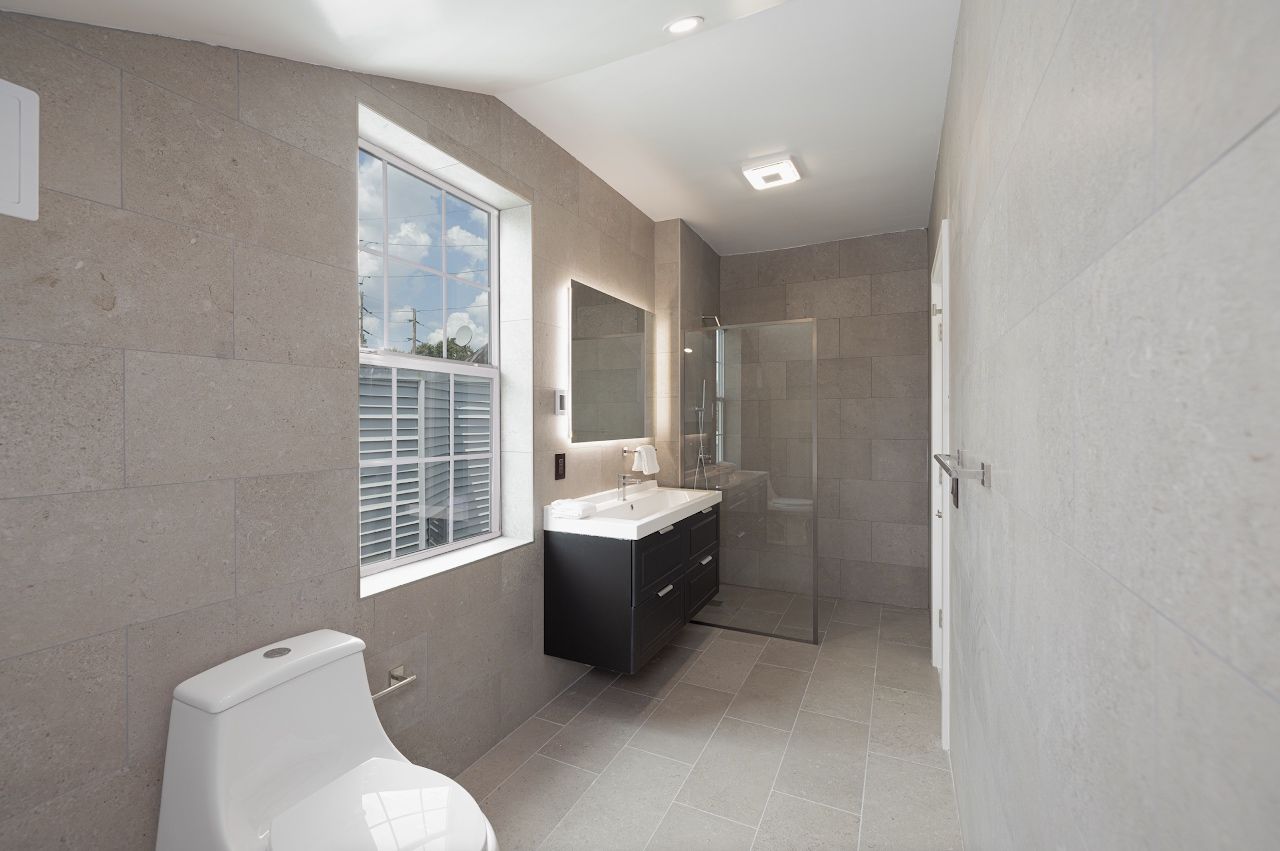
First question: gravity or pump?
Everything in a basement bathroom design follows from where the house’s waste leaves the building. Find the main building drain and where it exits the foundation wall or runs under the slab.
- The drain exits through the wall above the floor. Common in older Jersey City, Hoboken and Bayonne rowhouses and in many North Jersey colonials. Fixtures on the basement floor are below the outlet, so waste cannot flow out by gravity. You need an ejector pump.
- The drain runs under the slab and is deep enough. You may be able to break the slab, trench, and tie the new toilet, shower and sink into the existing line with proper slope (typically about a quarter inch per foot). This is the cheaper, quieter option, and it has no pump to fail. Some builders rough in basement drains for this reason.
- Partial gravity. Sometimes a sink can drain by gravity while the toilet and shower cannot. The plumber designs around the lowest fixture.
We camera-scope the existing line before pricing; old cast-iron or clay pipe under a slab is often cracked or bellied.
How a sewage ejector system works
An ejector system is a basin set into the floor (or a packaged unit beside the fixtures), a pump with a float switch, and a discharge line that lifts waste up and into the building drain above. What it involves in practice:
- A sealed, gas-tight basin. Unlike a sump pit for groundwater, a sewage basin holds waste, so the lid is sealed and the basin is vented.
- Its own vent. Plumbing codes commonly require the basin vent to connect to the vent system or run independently to the outdoors. In a finished basement this means a vent route up through the house or out the wall and up, which affects where the bathroom can go.
- Check valve and shutoff. The discharge line gets a check valve to stop waste from draining back into the basin and a full-open valve so the pump can be serviced.
- A dedicated circuit and an alarm. The pump goes on its own electrical circuit, and we add a high-water alarm so a failed pump is noticed before the basin overflows.
- Access. Pumps last years, not forever. Leave the basin lid accessible behind a removable panel, never under tile.
Macerating (upflush) toilets are a smaller alternative: a unit behind the toilet grinds and pumps waste through a small pipe. They suit a powder room with limited budget, but they are noisier, handle less, and acceptance for a full bathroom varies. The plumbing subcode official makes the call, so confirm before designing around one.
Backwater valves and sewer backups
Basement fixtures are the lowest openings in the house. If the municipal sewer surcharges in a heavy storm, sewage can come up through a basement floor drain, shower or toilet before it shows anywhere else. This matters in much of older Hudson County, where Hoboken, Weehawken, Union City, West New York and large parts of Jersey City are served by combined sewers that carry both stormwater and sewage.
A backwater valve on the building drain lets waste flow out but closes when the sewer backs up. Whether your basement bath needs one, and where it goes, depends on the existing piping and the plumbing inspector’s reading of the code. We raise it on every basement bath in low-lying towns. Separately, ask your insurer whether your policy covers sewer backup; many homeowner policies need an endorsement for it.
Permits in New Jersey
Under the Uniform Construction Code, a permit is required to construct or alter a building or install regulated plumbing and electrical work. A new basement bathroom adds fixtures, drains and vents, so it is not ordinary maintenance. Expect:
- Plumbing permit for the fixtures, ejector, vent and any backwater valve. New Jersey’s plumbing subcode is based on the National Standard Plumbing Code with state amendments, and the work should be done by a New Jersey licensed master plumber.
- Electrical permit for lighting, GFCI-protected receptacles, the exhaust fan and the pump circuit.
- Building permit for framing new walls, insulation, and finishing the space as habitable area.
Inspections usually happen at rough plumbing (before the slab is patched), rough electrical and framing, insulation, and final. Permits are issued by your local construction office; the state keeps a directory. Our NJ renovation permit guide covers fees and timing in more detail.
Two code items catch people out. First, the bathroom needs ventilation: an openable window or an exhaust fan ducted outdoors, not into a joist bay or the furnace room. Second, ceiling height. Low basements with ducts and beams can make a finished bathroom tight, and the construction office will check finished heights against the residential code. Measure under the lowest beam or duct before committing to a layout.
Flood hazard areas: check before you design
This is where New Jersey basements differ most from basements elsewhere. Parts of Hoboken, Jersey City, Bayonne, the Meadowlands towns and many riverfront neighborhoods in North Jersey sit in FEMA-mapped flood hazard areas, and New Jersey layers its own flood rules on top of the federal ones.
- Look up the map. FEMA’s Flood Map Service Center shows whether your address is in a Special Flood Hazard Area. Your town’s floodplain administrator (often in the engineering or construction office) can tell you the design flood elevation.
- The 50 percent test. Under N.J.A.C. 5:23-6.3A, if work on an existing building in a flood hazard area is a substantial improvement, meaning its cost equals or exceeds 50 percent of the structure’s market value, the building must meet flood-resistant construction requirements. The local floodplain administrator makes that determination, and in many towns improvements are counted cumulatively.
- Below-grade space. State flood hazard rules prohibit habitation of enclosures below the lowest floor and require them to be modified when a building is substantially improved. In practice, a basement below flood elevation in a substantially improved house generally cannot be finished as living space with a bathroom, and in some cases it has to be filled or converted.
A basement bath on its own rarely reaches 50 percent of a house’s value, but it often happens as part of a larger renovation, and that is when the test bites. If you are in a mapped flood zone, we involve the floodplain administrator at the start, not after the design is drawn.
Moisture, radon and materials
- Solve water first. If the basement takes water, fix grading, gutters and leaders, and add interior drainage or a sump before finishing. A bathroom will not survive a wet foundation.
- Test for radon. The NJ Department of Environmental Protection recommends testing all homes, in the lowest livable level, and parts of North Jersey have elevated radon. If a short-term test reads at or above the EPA action level of 4 pCi/L, plan mitigation before you close walls; a sub-slab system is easier to route during construction.
- Use materials that tolerate damp. Porcelain tile floors, a waterproofing membrane in the shower, mold-resistant board, closed-cell or rigid insulation against concrete, and no wood or carpet on the slab.
2026 cost ranges
For comparison, a full bathroom remodel in an existing New Jersey bathroom runs $20,000 – $40,000. A new basement bathroom costs more because you are also creating the plumbing, walls, ventilation and finishes from scratch.
| Scope | 2026 planning range (NJ) |
|---|---|
| Half bath, gravity drain under slab | $18,000 – $35,000 |
| Half bath with macerating toilet (where allowed) | $15,000 – $28,000 |
| Full bath with sewage ejector pump | $40,000 – $80,000 |
| Ejector system alone (basin, pump, vent, alarm, installed) | $4,000 – $9,000 |
| Backwater valve on the building drain | $1,500 – $4,500 |
| Radon mitigation system, if needed | $1,200 – $3,000 |
2026 planning ranges, not quotes: labor, materials and permits. Slab trenching distance, a damaged lateral, vent routing and finish level move a project within or above these ranges.
How we approach it
At the site visit we find the building drain and its depth, scope the line, check ceiling heights and look for signs of water. We check the flood map and, if the address is in a flood hazard area, talk to the floodplain administrator before drawing a plan. Then we tell you whether gravity or a pump makes sense, which permits apply, and what it costs. If the basement bath is part of a larger project, see our bathroom renovation and New Jersey pages, or our guide to adding a bathroom elsewhere in the house.
Frequently asked questions
Do I need an ejector pump for a basement bathroom?
Only if the new fixtures sit below the building drain or sewer line. If the drain leaves the house through the foundation wall above the floor, or the under-slab line is too shallow, waste has to be pumped up. If a deep enough line runs under the slab, the bathroom can often drain by gravity.
Do I need a permit for a basement bathroom in New Jersey?
Yes. A new bathroom adds fixtures, drains and vents, so it needs a plumbing permit, an electrical permit and usually a building permit from your town's construction office under the Uniform Construction Code.
Can I put a bathroom in a basement in a flood zone?
Sometimes, but check first. If the work, alone or with other improvements, counts as a substantial improvement (50 percent or more of the structure's market value), New Jersey's flood rules generally do not allow habitable space below the flood elevation. Your local floodplain administrator decides.
Are upflush or macerating toilets allowed in NJ?
They can be accepted in some situations, typically for a powder room, but it depends on the installation and the local plumbing subcode official. Confirm before you design around one.
How much does a basement bathroom cost in New Jersey?
In 2026, plan on roughly $18,000–$35,000 for a half bath that drains by gravity and $40,000–$80,000 for a full bath with a sewage ejector pump, including permits.
Sources & further reading
- N.J.A.C. 5:23-2.14: Construction permits, when required
- N.J.A.C. 5:23-3.15: Plumbing subcode
- N.J.A.C. 5:23-6.3A: Flood hazard areas, substantial improvement
- N.J.A.C. 7:13-12.5: Flood hazard area rules for buildings
- FEMA Flood Map Service Center
- NJ DEP Radon Program
- US EPA: Radon
- NJ DCA: Local construction offices
Costs are 2026 planning ranges for the New Jersey and New York City market, not quotes. Rules summarized here change and vary by building and municipality; confirm requirements with your local building department, building management or attorney before you start.